

Broadband.io: How Massachusetts’ Broadband Office Is Ending the ‘Deflategate’ Era of Inadequate Broadband Service
Recently I had the opportunity to dig deep on a state that, admittedly, doesn’t have much left to connect. But for Michael Baldino, Director and General Counsel of the Massachusetts Broadband Institute (MBI), connectivity is the journey, not a destination.
MBI, Massachusetts’s SBO, is one arm of the Massachusetts Technology Collaborative (MassTech), a large quasi-public economic development organization established in 1982. MBI was created in 2008, making it… if not the oldest, one of the older state broadband offices in the country.
The SBO was placed in MassTech because of its early efforts to aggregate demand for internet service in western Massachusetts as well as to distribute computers into schools across the state. “One of the things the legislature recognized is that when they have technology policy goals, MassTech is the best place to run and implement tech programs. MBI aligns with MassTech’s mission, which really is driving economic growth through innovation.”
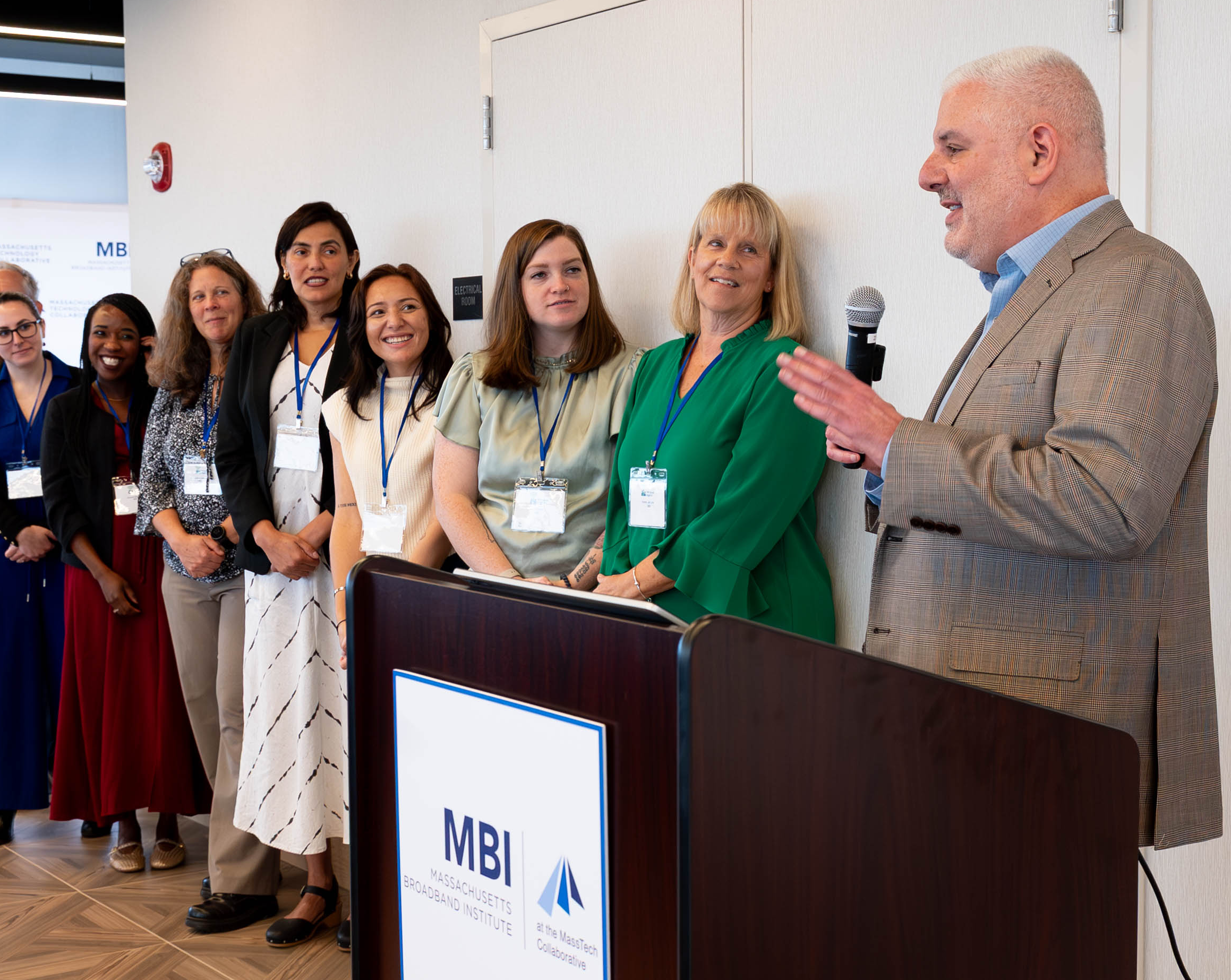
MBI staff look on as Massachusetts Broadband Institute (MBI) Director Michael Baldino speaks at the MA Goes DigitALL event Wednesday, Oct. 8, 2025, at the Top of the Tower in Worcester, Massachusetts. (Photo by MassTech)
Broadband’s Colonial Times
As a foundation for future Commonwealth connectivity, Massachusetts itself matched a $45M BTOP grant in 2009 to build a ~1K middle-mile network. The network would connect hundreds of community anchor institutions and benefit thousands of ‘Bay Staters.’
Fast forward to a completed middle-mile network, MBI turned its attention to expanding rural broadband connectivity, specifically on the western half of the Commonwealth. Baldino recounts that there were 44 rural western towns that had no broadband connectivity whatsoever and an additional nine that had significant service gaps. “So our initial mission was to bring broadband to those communities,” Baldino explains.
“We implemented last-mile grant programs to get each of these communities up to at least a minimum of 96% coverage, while some of these communities got to 100%,” recounts Baldino. Baldino tells me that these builds were funded by state bond funds to absorb the capital costs associated with building networks that were started in 2016 and wrapped in 2025.
Baldino recounts working with each of the individual communities to develop an individual plan that was right for each. “We wanted to empower communities to have a voice to determine what the best option was for them.”
Almost half of the 44 communities chose a path where they would own and operate a municipal owned fiber network with a portion of the cost to design and construct the network covered through state bond funds. These towns bonded and took on long-term debt to fund the remainder of those costs.
The municipal broadband provider in Westfield, Massachusetts, Whip City Fiber, took on the role of owner’s project manager for the municipal broadband networks in western Massachusetts, passing ~31K BSLs. “With Westfield’s municipal fiber network already in place, it was best positioned to take on the role of supporting these 20 communities,” says Baldino.
Baldino says Westfield took the lead on design engineering and construction management for the builds. Today, Whip City Fiber serves as network operator for these communities. “They [Whip City] were a critical partner to get municipal fiber networks built.”
The remaining communities decided public-private partnerships were their best bet. MBI awarded ISPs the funding to build networks and deliver coverage. Large providers like Comcast and Charter as well as smaller providers, such as Fiber Connect, received grants for rural builds.
In total, Massachusetts’ own investment totaled $95M in state and municipal funding to provide the resources needed to connect communities.
The Pandemic that Changed the Playbook
Baldino tells me that the pandemic created a ‘pivot point’ for MBI. Baldino and his team would evolve from rural broadband connectivity to one that would also lead statewide efforts to address the pandemic’s challenges. Those that could be addressed through broadband and digital equity investments.
One newly established program called Mass Internet Connect would help people ‘economically displaced by the pandemic’ to get back into the workforce. Support from MBI would come partly through a partnership with the MassHire Career Development Centers, a statewide network of job centers to work with unemployed job seekers.
MBI also provided devices where they were needed in the form of distributing approximately 11,000 Chromebooks, internet service subsidies, and access to digital skills resources.
While the unserved communities in western Mass waited (during the pandemic) for their broadband networks to be completed, MBI deployed hotspots in community anchors, such as libraries and town halls that provided residents with internet access for remote work and school.
The Commonwealth’s Pandemic Response
ARPA SLFRF funding totaling $75M was allocated to MBI to implement digital equity programs. The Digital Equity Partnerships Program awarded multimillion-dollar grants to ‘high-capacity organizations’ to implement one or more of the MBI’s six different initiatives. Much of this funding supported “…community-based organizations on the front line of bridging the digital divide. This is real meaningful impact,” explains Baldino.
Distributing ~21K devices.
Helping more than 80K people with direct digital navigation support.
Improving connectivity in more than 30 public spaces.
Funding ~120 digital navigators.
Other programs funded in Massachusetts by ARPA’s $75M were municipal digital equity planning and implementation programs. Towns and cities without digital equity plans were guided through the process by MBI. A remarkable 115 towns and cities opted to participate. MBI provided dedicated support to design and draft a customized (informed by the residents and by the stakeholders) digital equity plan for each community. MBI also provided grants directly to the towns and cities to implement high-priority projects identified in their digital equity plans.
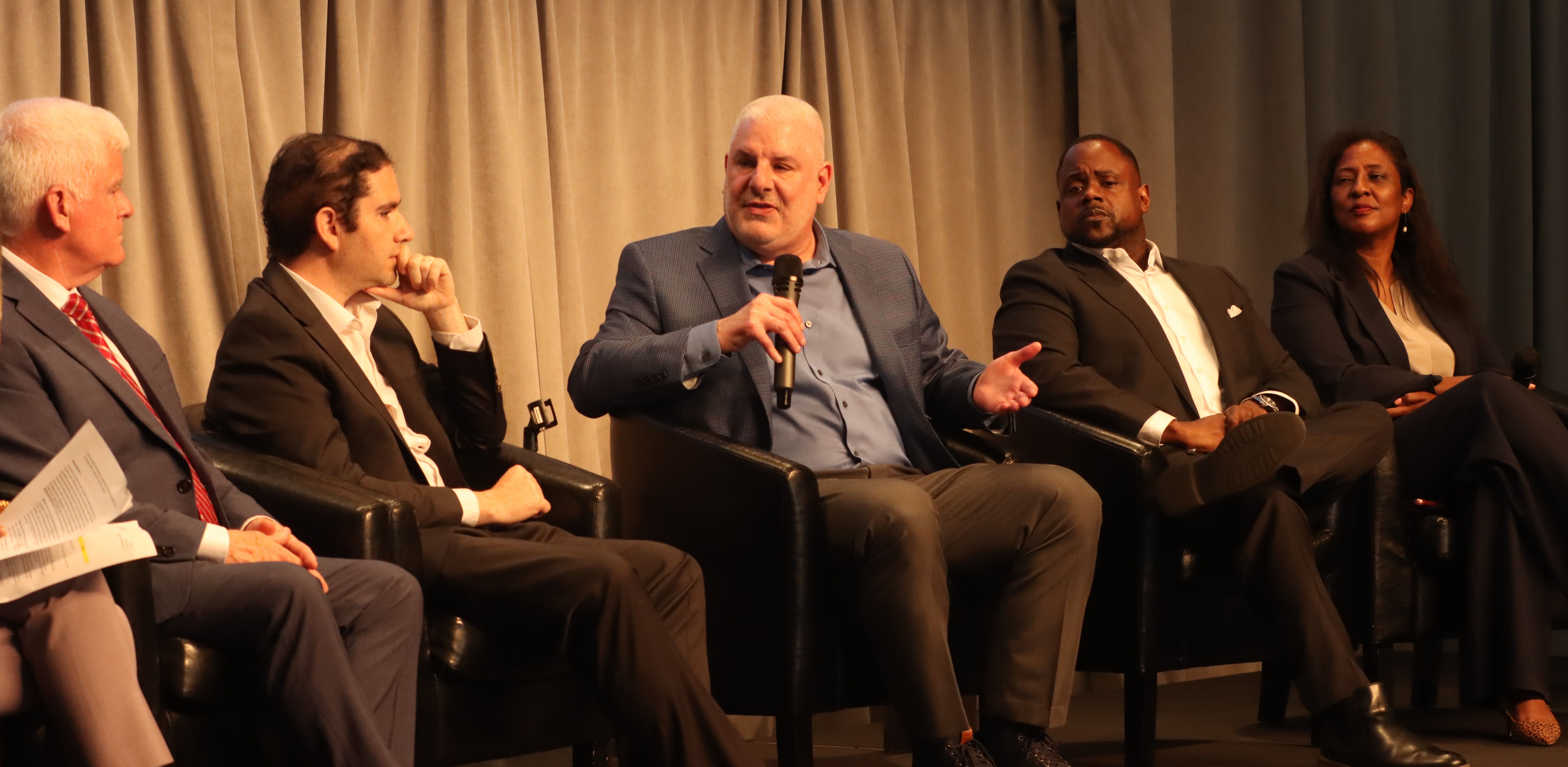
Massachusetts Broadband Institute Director Michael Baldino, center, speaks during a panel discussion at an event celebrating 30 years since the Telecommunications Act on Tuesday, May 26, 2026, in Cambridge, Massachusetts. Also pictured, from left, are Westfield General Electric Assistant General Manager Joe Mitchell, Boston Chief Information Officer Santi Garces, The Loop Lab CEO Rev. Chris Hope and Massachusetts Immigrant and Refugee Advocacy Coalition (MACI) Legal Director Virginia Benzan. (Photo by MassTech)
On to Cincinnati CPF
Baldino tells me that CPF funded several programs in Massachusetts.
The Retrofit Program ($74M) replaced old and antiquated wiring in public and affordable housing properties statewide. In all, 32K units are being rewired in 102 Massachusetts towns and cities. “Even if a location was considered served under the FCC's maps, the internal wiring actually going to each unit didn’t allow residents to get the full benefit of the broadband service,” says Baldino. “And I think one of the things that we're really proud of is there aren't many states doing this type of program.” Editor’s Note: There should be.
The complementary RANGE Program ($9M) provided grants to housing operators to hire tenant coordinators to engage with their residents to make sure residents knew about the opportunities provided by the Residential Retrofit projects. In some cases, housing authorities hired digital navigators through this program and/or distributed devices and provided digital skills training.
The Gap Networks Program ($45M) is expanding access to ~5K unserved and underserved locations across the state.
Connected Online ($30M) distributed more than 31,000 devices (laptops, tablets, etc.) to ~250 organizations.
Beantown BEAD
For Massachusetts, initial BEAD deployment grant awards are ~$19M to connect 3,808 BSLs and CAIs. Technology designations broke out to nearly half HFC (49%), 35% LEO, and 16% fiber.
Baldino anticipates that the ‘true up’ round will reveal another ~2,000 to 2,500 locations that need to be connected. With more than $100 million in BEAD funding remaining for Massachusetts, MBI is sure to have plenty of funding remaining after the second round of BEAD deployment grants.
I asked Baldino what it is like to be so close to universal coverage and he pushes back… just a little. “The job's never done to fully close the digital divide, but we feel great that we've done everything we can to connect BSLs… right now, being at only one-tenth of one percent needing to be connected, we're definitely on the pathway to universal service.”
“We have our statewide digital equity plan and depending on what’s permittable once the remaining BEAD funds are made available, we have a full list of options to consider,” says Baldino.
I am not sure I’ve talked to a state more prepared for non-deployment dollars, should they come. “We're able to focus on literacy, adoption, and affordability. I feel fortunate to be in a state that’s made the commitment to connect people to make sure everyone has full access and is able to take advantage of broadband,” says Baldino.
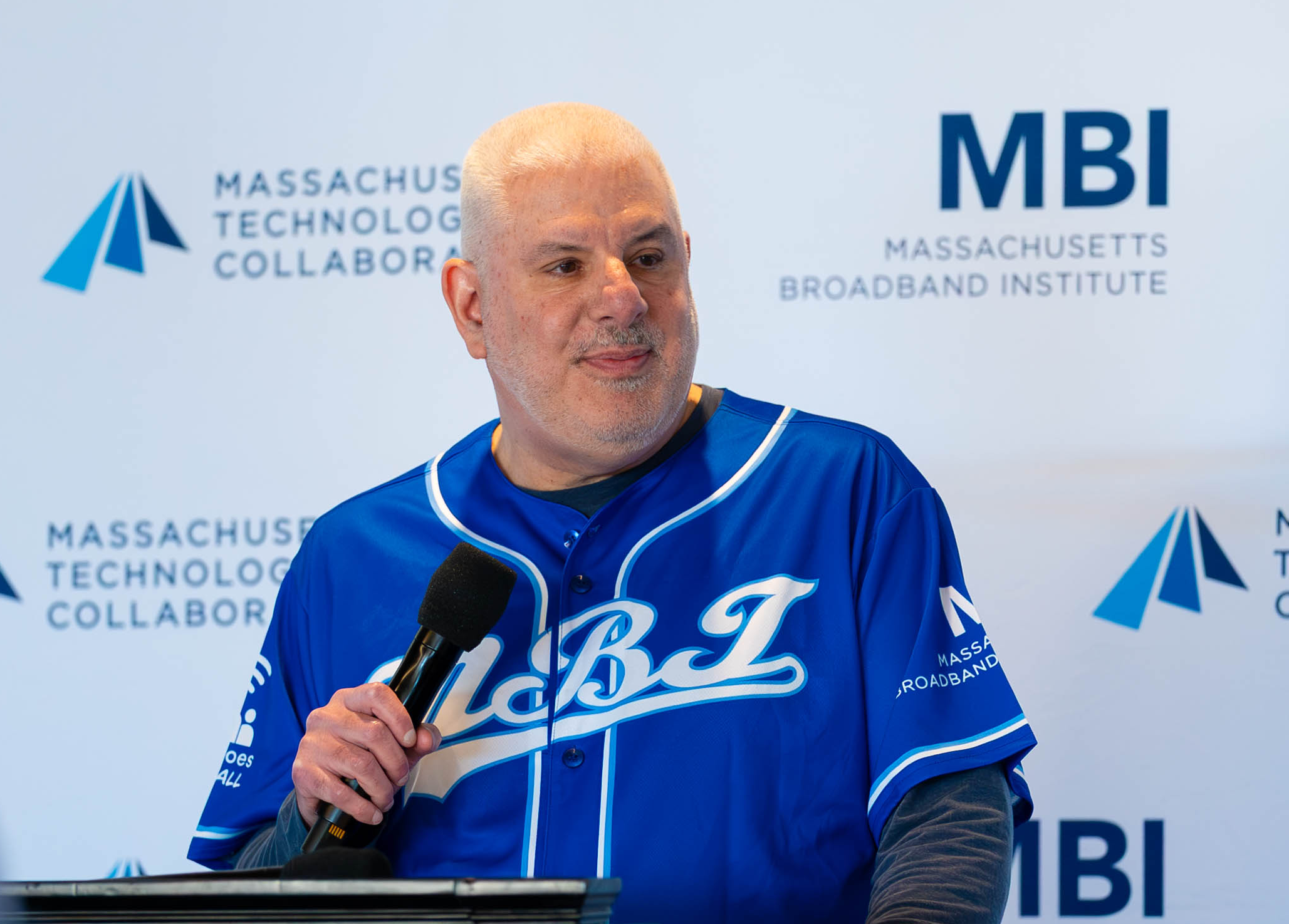
Massachusetts Broadband Institute (MBI) Director Michael Baldino speaks at the MA Goes DigitALL event Tuesday, Oct. 6, 2026, at Polar Park in Worcester, Massachusetts. (Photo by MassTech)
A Broadband Patriot
Baldino grew up in upstate New York, attended SUNY Albany for his undergraduate, and since has spent his whole life in the public sector.
Law school took him to Boston University, and he’s been in Massachusetts ever since. He tells me that his first post-law school job was working for the Senate Committee for Science and Technology in the Massachusetts state legislature.
In 1995, he joined MassTech and has been working on technology, innovation, and connectivity for more than 30 years.
He’s been working on broadband issues for nearly 20 years. Adding to his portfolio are e-health and clean energy experiences. “I work on really meaningful policy goals for the state, a privilege, really,” says Baldino.
“But this [broadband connectivity] has been the most gratifying part of my career. I am really proud of what we've been able to accomplish as a team,” says Baldino. “We have an amazing staff of 15 and what's really impressive is the folks who have joined us have stayed with MBI. They’re invested in the mission. Which, honestly, is how we hire. More than tech or telecom savviness, we look for folks passionate about what we’re trying to do.”
Views expressed are the author’s own and do not necessarily represent the official position of broadband.io or its affiliates. Contact Doug Adams at doug@broadbandmarketers.com with any comments or questions.
Legal Disclaimer:
EIN Presswire provides this news content "as is" without warranty of any kind. We do not accept any responsibility or liability for the accuracy, content, images, videos, licenses, completeness, legality, or reliability of the information contained in this article. If you have any complaints or copyright issues related to this article, kindly contact the author above.
